
.webp?width=254&height=134&name=Image%20(7).webp)
.webp?width=72&height=78&name=Vector%20(6).webp)
-1.webp?width=254&height=137&name=Ellipse%201%20(1)-1.webp)




This is the 3rd of 5 articles in our white paper on Inbound lead generation. In the course of your reading, you'll learn, among other things, how to generate and qualify inboundleads, what the standards are for lead generation, plus practical tips for generating inboundleads.
Here's the link to the1st and 2nd articles, in case you haven't read them :
Why not just buy leads and how to qualify your leads
We'll be publishing one article a week. If you can't wait to read all the content, you can immediately download our white paper which includes all the articles by filling in the following form:
Download our white paper on lead generation
You're driving traffic to your website and boosting your lead list . Great work! But what about your position in relation to your competitors? How many leads would you need to generate to become a major player in your market?
It's hard to know if your lead generation strategy is working without taking into account data from your industry in general. HubSpot teamed up with Qualtrics to survey over 900 marketers from various industries in North America and Europe. The objective was to create a report that would demonstrate how different companies generate demand for their offering. They collected data on web visitors, leads, opportunities, customers and revenue.
The results:
It turns out that 74% of companies that don't reach their revenue targets have no idea how many visitors, leads, MQLs or sales opportunities they have! What's more, 70% of companies that miss their revenue targets generate fewer than 100 leads per month, and only 5% generate more than 2,500 leads per month.*
*U.S. data
Cost per lead by industry
The media and publishing industries enjoy the lowest cost per lead, ranging from $11 to $25. Software, service and IT companies, marketing agencies and financial services companies report the highest average cost per lead: $51 to $100.
Leads generated per month, by annual sales
Unsurprisingly, the higher a company's sales, the more leads it needs to generate . The biggest differences are at the extremes of the spectrum: 82% of companies with annual sales of $250,000 or less report generating fewer than 100 leads per month, while only 8% of companies with $1 billion in annual revenues generate fewer than 100 leads per month.
Leads per month
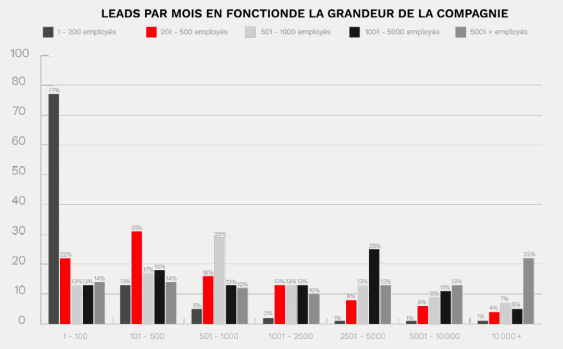
58% of companies surveyed generate 500 or fewer leads per month, and 71% generate 1,000 or fewer. However, as we saw earlier, the most successful companies are also those that generate the most leads. Let's break down the data by company size:
Lead generation software
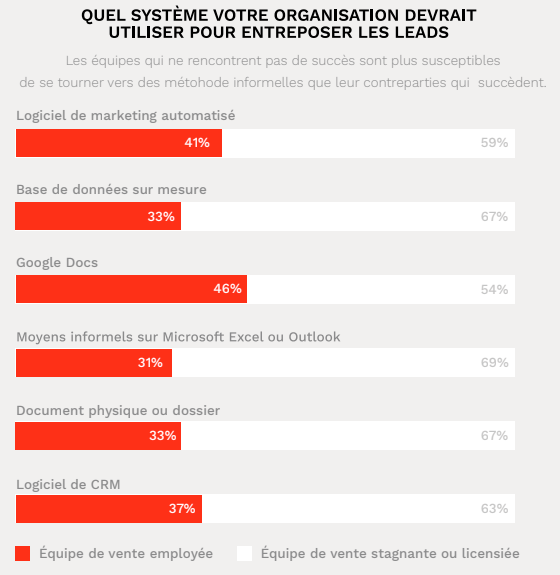
We also noticed that the most successful marketing teams use a suitable platform to classify and store their leads : 46% use Google Docs, 41% use marketing automation software and 37% use CRM (customer relationship management) software. (Tip for HubSpot customers: you can integrate Google Drive with HubSpot Marketing Hub and HubSpot CRM).
Now that we've covered lead generation trends and standards in this article, we'll talk about lead generation strategies in the next. If you're eager to learn more right away, we invite you to download our white paper by filling out the following form:
Download our white paper on lead generation
Once again, here's the link to the first 2 articles in the series you've just read: